
Every year on March 14, math enthusiasts, students, scientists, and educators around the world celebrate Pi Day, a day dedicated to one of the most important numbers in mathematics—π (Pi). This special day is not only about numbers and equations but also about creativity, curiosity, and appreciation for mathematics. From classrooms and universities to online communities, Pi Day brings people together to explore the beauty and significance of this fascinating constant.
What Is Pi?
Pi (π) is a mathematical constant that represents the ratio of a circle’s circumference to its diameter. No matter how big or small the circle is, this ratio always remains the same.
\pi = \frac{C}{D}
Here, C represents the circumference of the circle and D represents the diameter. The value of π is approximately 3.14159, but it is an irrational number, meaning its decimal representation goes on forever without repeating.
Mathematicians and computer scientists have calculated trillions of digits of π, but for most practical calculations, only a few decimal places are required.
Why Is Pi Day Celebrated on March 14?
Pi Day is celebrated on March 14 because when written in the month/day format used in many countries (3/14), it matches the first three digits of π: 3.14.
The date perfectly represents the number and provides an easy way for people to remember and celebrate it. Many celebrations even start at 1:59 PM, representing the next digits of π: 3.14159.
The History of Pi Day
The idea of Pi Day was first introduced in 1988 by Larry Shaw, a physicist working at the Exploratorium in San Francisco.
Shaw and his colleagues celebrated the day by:
- Marching in a circle
- Eating fruit pies
- Discussing mathematics and science
The celebration quickly gained popularity among educators and math lovers. Eventually, in 2009, the United States Congress officially recognized Pi Day as a national celebration of mathematics and science education.
Since then, Pi Day has become an international event celebrated in schools, universities, and research institutions worldwide.
Importance of Pi in Mathematics and Science
The number π plays a crucial role in many areas of mathematics, engineering, and physics. It appears in formulas related to circles, spheres, waves, and even probability.
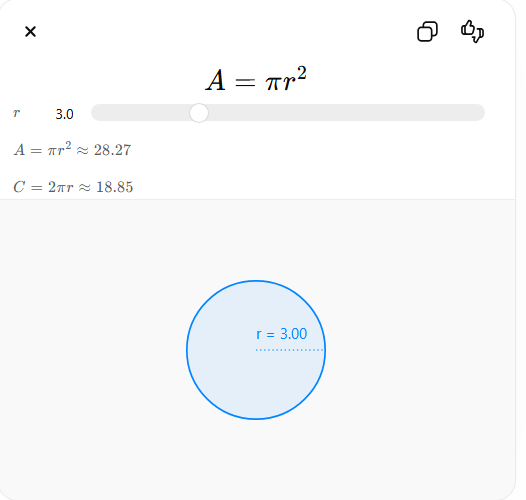
For example, the area of a circle depends on π.
r
A=πr2≈28.27
C=2πr≈18.85r = 3.00
Here:
- A is the area of the circle
- r is the radius of the circle
This formula is used in countless real-world applications such as architecture, engineering design, and manufacturing.
Pi also appears in:
- Calculating the volume of cylinders and spheres
- Wave and vibration analysis
- Signal processing
- Quantum physics
- Astronomy
Without π, many scientific calculations used to understand the universe would not be possible.
Fun Facts About Pi
Pi is not just important—it is also fascinating. Here are some interesting facts about this famous number:
1. Pi Never Ends
The digits of π continue infinitely without any repeating pattern.
2. Billions of Digits Have Been Calculated
Supercomputers have calculated trillions of digits of π to test computational power and algorithms.
3. Pi Appears in Unexpected Places
It shows up in formulas related to probability, statistics, and even chaos theory.
4. There Is a Pi Memorization Competition
Some people compete to memorize as many digits of π as possible. The current world record involves memorizing tens of thousands of digits.
5. Albert Einstein’s Birthday
Interestingly, Pi Day is also the birthday of Albert Einstein, one of the most famous scientists in history.
How People Celebrate Pi Day
Pi Day celebrations are both educational and entertaining. Schools, math clubs, and science organizations organize special activities such as:
1. Eating Pie
Since “pi” sounds like “pie,” people celebrate by eating different types of pies such as:
- Apple pie
- Pumpkin pie
- Chocolate pie
2. Math Competitions
Students participate in math puzzles, quizzes, and competitions related to π and geometry.
3. Memorizing Pi Digits
Many participants try to memorize as many digits of π as possible.
4. Pi-Themed Art and Activities
Creative activities such as drawing circles, making π symbols, or writing poetry about mathematics are also popular.
5. Educational Events
Universities and science centers host lectures and workshops explaining the importance of mathematics and science.
Pi Day and Education
One of the biggest goals of Pi Day is to encourage interest in mathematics and STEM education. Teachers use this day to make math more engaging for students through fun activities and experiments.
Students learn that mathematics is not just about solving problems but also about exploring patterns and understanding the world around them.
Pi Day helps remove the fear often associated with math and replaces it with curiosity and excitement.
Global Recognition of Pi Day
Over the years, Pi Day has grown into a worldwide celebration. Schools in countries across the globe organize math festivals, coding challenges, and science exhibitions.
Technology companies, educational platforms, and research institutions also participate by sharing puzzles, videos, and interactive learning activities related to π.
Social media platforms often trend with hashtags related to Pi Day as people share fun facts, jokes, and mathematical challenges.
Conclusion
Pi Day is much more than a celebration of a number. It represents humanity’s curiosity about mathematics, science, and the universe. The number π has played a critical role in scientific discovery for thousands of years and continues to inspire mathematicians and researchers today.
By celebrating Pi Day, people around the world recognize the importance of mathematics in everyday life—from engineering and technology to space exploration and modern computing.
Whether you celebrate by solving math puzzles, learning new facts about π, or simply enjoying a slice of pie, Pi Day reminds us that mathematics can be both meaningful and fun.
So every year on March 14, take a moment to appreciate the beauty of π and the endless possibilities it represents.


