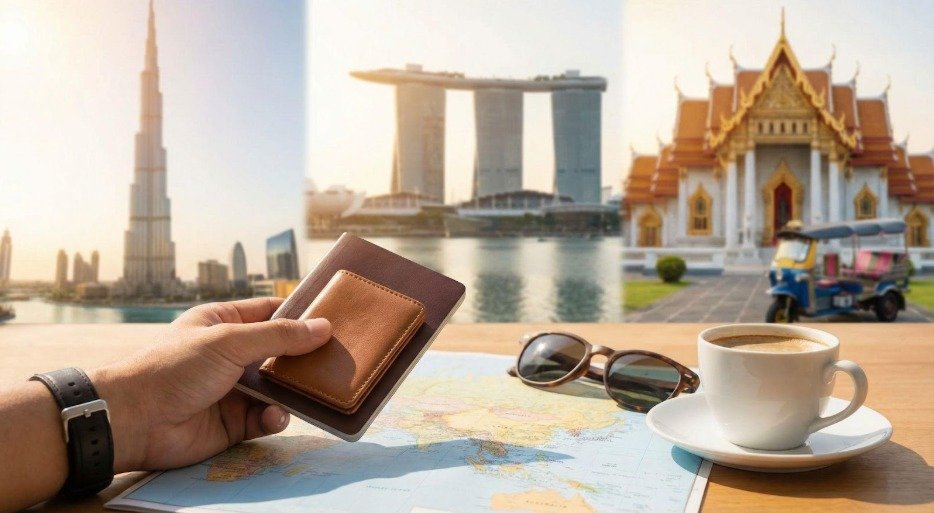
For the Indian globetrotter, the trio of Dubai, Singapore, and Thailand represents the “Golden Triangle” of international travel. Whether it is the futuristic skyline of Dubai, the manicured efficiency of Singapore, or the tropical allure of Thailand, these destinations are accessible, vibrant, and incredibly popular. However, each of these regions has a distinct financial culture. While one might be almost entirely cashless, another might require you to carry a stack of physical notes for local markets. Exploring these differences requires a smart approach to travel finance, moving beyond the traditional multicurrency forex card to more agile, digital-first solutions.
From the 7-Elevens of Bangkok to the MRT in Singapore and the luxury malls of Dubai, here is a practical guide to managing your money effectively.
Exploring the glitz of the Emirates
Dubai is a city that prides itself on being at the forefront of technology. Consequently, the payment infrastructure is world-class. If you are carrying a forex card in Dubai, it will be your primary mode of payment in almost every mall, hotel, and high-end restaurant.
- Cashless convenience: From the Dubai Mall to Global Village, contactless “Tap & Pay” is the norm. Most merchants prefer card payments over cash for hygiene and speed.
- The Souk exception: While the city is modern, traditional spots like the Gold Souk or the Spice Souk in Deira still value cash. Small vendors might offer a better “cash price” for jewellery or textiles, so having a card that allows low-cost ATM withdrawals is essential.
- Public transport: To use the Dubai Metro or RTA buses, you need a “Nol Card.” While you cannot tap your travel card directly on the metro gates, you can use your forex card in Dubai to top up your Nol Card at any station kiosk.
Efficiency in the Lion City: Singapore
Singapore is arguably one of the most card-friendly cities in the world. The city-state has made significant strides in becoming a cashless society, making a forex card an absolute necessity for daily survival.
- SimplyGo for transit: One of the best features of Singapore’s public transport is the “SimplyGo” system. You do not need to buy a separate Ez-Link card anymore. You can simply tap your contactless forex card in Singapore at the gantry of any MRT station or on any public bus. This saves you the hassle of queuing for top-ups.
- Hawker centres: Traditionally cash-only, many hawker centres now accept digital payments via QR codes. However, as an international traveller, QR code compatibility can be tricky. It is wise to carry a small amount of Singapore Dollars(SGD)for that Michelin-star chicken rice.
- Strict regulations: Singapore has strict rules regarding the condition of physical currency. If you are carrying cash, ensure the notes are crisp and untarnished. Using a digital forex card in Singapore removes this headache entirely.
The tropical charm of Thailand
Thailand offers a different experience compared to the other two. While Bangkok and Phuket are modernising, Thailand remains a relatively cash-heavy economy, especially in the islands and local night markets.
- The ATM fee hurdle: This is the most important thing to know about using a forex card in Thailand. Almost every Thai bank charges a flat fee of 220 Thai Baht (THB) per withdrawal for international cards. To minimise this, it is better to withdraw a large amount in one go rather than making multiple small trips to the ATM.
- 7-Eleven dominance: These convenience stores are on every corner and are a lifesaver for travellers. Most 7-Elevens in Thailand accept card payments, but often only for transactions above 200 or 300 THB.
- Night markets and street food: From the Chatuchak Market to the street stalls of Yaowarat, cash is king. Ensure your forex card in Thailand is backed by an app that helps you find the nearest surcharge-free ATM to replenish your Baht.
Limitations of the traditional multicurrency forex card
For years, the multicurrency forex card was the standard recommendation for Indians. The idea was to load specific “buckets” of USD, SGD, or AED. However, this model has several flaws:
- Guesswork: You have to predict exactly how much you will spend in each currency. If you run out of SGD but have leftover AED, the “cross-currency” conversion fees are often exorbitant.
- Loading fees: Traditional banks often charge a fee every time you load or reload the card.
- The “Unloading” loss: When you return to India, you have to sell back the remaining foreign currency to the bank at a significantly lower rate than what you bought it for.
Why Niyo is the smarter choice for these destinations?
To truly enjoy your trip to Dubai, Singapore, or Thailand, you need a solution that adapts to your location without the restrictions of a multicurrency forex card. Niyo redefines the travel banking experience by being a 100% digital, INR-based account.
Zero forex markup
Whether you are swiping at a boutique in Dubai or an MRT station in Singapore, Niyo offers zero forex markup. This means you get the live VISA exchange rate without any hidden “convenience” fees that traditional banks usually add.
The INR advantage
Unlike a multicurrency forex card, you don’t have to pre-load specific currencies. You keep your money in INR in your Niyo account. When you spend in Thailand or Dubai or Singapore, your INR is instantly converted to THB, AED or SGD, respectively. There is no guesswork and no leftover foreign balance to “sell back” at a loss when you return home.
Integrated travel tools
The Niyo app is a comprehensive travel companion designed for these specific routes, with the following benefits:
- International eSIM: Stay connected from the moment you land in Suvarnabhumi or Changi. Niyo offers eSIM plans starting from just ₹50, manageable directly within the app.
- ATM locator: Find the nearest ATM anywhere in the world and use the “Free” tab to identify machines that do not charge a local surcharge fee.
- International lounge access: Spending ₹50,000 in international transactions within a calendar quarter earns you a free Lounge Pass. This is perfect for long layovers at Changi Airport (Singapore) or Dubai International.
- Travel insurance and Visa: Apply for visas and secure group travel insurance for up to 10 people directly through the app, ensuring you are covered for medical emergencies or lost baggage.
- Enhanced security: You can instantly Lock, Unlock, or Block your card or individual payment channels (like ATM or Online)through the app.
- Real-time tracking: Every spend in Dirhams is listed in the app and instantly converted to INR for your record, helping you stay on budget.
- Tap & Pay: The card facilitates contactless payments, ensuring quicker transactions without the card ever leaving your hand.
Final word
Each destination in the “Golden Triangle” requires a slightly different financial strategy. While Dubai and Singapore reward card-heavy travellers, Thailand requires a balanced approach to cash. By moving away from the rigid structure of a multicurrency forex card and embracing the flexibility of Niyo’s Zero Forex Markup cards, you can understand these differences with ease.
With zero forex markup, real-time INR conversion, and premium perks like lounge access, Niyo ensures your focus stays on the travel experience rather than the mechanics of payment. Load your account in Rupees, pack your bags, and explore the best destinations with the confidence that the best travel banking technology is right in your pocket.


