
Introduction
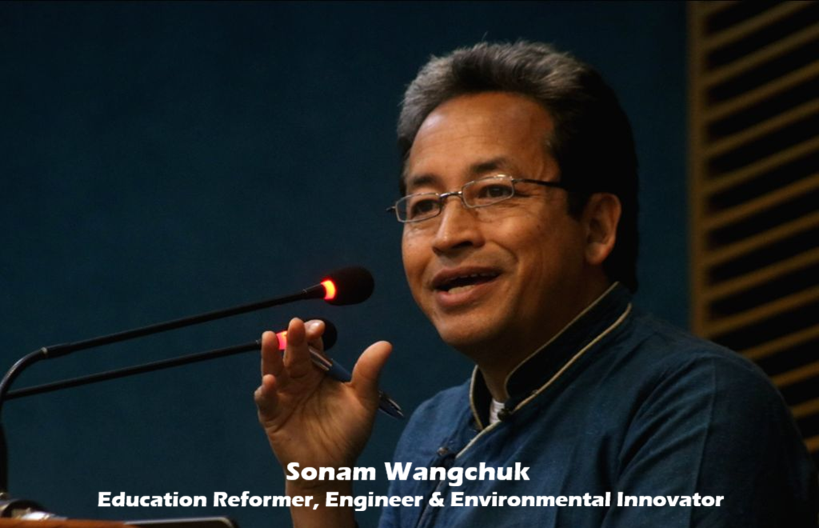
Sonam Wangchuk is one of India’s most respected innovators, engineers, education reformers, and environmental activists. Best known for his groundbreaking work in education and sustainable technology, Wangchuk has dedicated his life to solving real-world problems in the Himalayan region of Ladakh. His ideas have inspired millions across India and beyond, proving that innovation does not always require expensive technology—it requires creativity, local knowledge, and a commitment to improving society.
His contributions have earned him national and international recognition, including the prestigious Ramon Magsaysay Award, often referred to as Asia’s Nobel Prize. From developing alternative education models to inventing the famous Ice Stupa project, Sonam Wangchuk continues to demonstrate how science and community participation can address environmental and social challenges.
Early Life and Education
Sonam Wangchuk was born on September 1, 1966, in Uleytokpo, a small village in Ladakh, India. Growing up in a remote mountainous region, he experienced firsthand the challenges of limited educational opportunities and harsh climatic conditions.
During his childhood, formal education was not easily accessible. He initially learned at home before joining school later than most children. Because he spoke Ladakhi while schools primarily taught in Urdu, he struggled during his early years. These personal experiences later inspired him to improve the education system for children living in remote areas.
Wangchuk pursued engineering and earned a degree in Mechanical Engineering from the National Institute of Technology (NIT), Srinagar. His engineering background became the foundation for many of his future innovations.
Revolutionizing Education in Ladakh
Instead of pursuing a conventional engineering career, Sonam Wangchuk chose to focus on educational reform.
In 1988, he co-founded the Students’ Educational and Cultural Movement of Ladakh (SECMOL). The organization aimed to improve the quality of education while making learning more practical, engaging, and relevant to local communities.
At the time, government schools in Ladakh recorded poor academic results. Many students struggled because the education system did not consider local languages, culture, or environmental conditions.
SECMOL introduced several innovative approaches:
- Practical learning instead of rote memorization
- Student-led campus management
- Renewable energy-powered campuses
- Skill-based education
- Community involvement in learning
The SECMOL campus itself became a model of sustainability, where students actively participate in daily operations, including farming, cooking, maintenance, and energy management.
Inspiration Behind the Movie 3 Idiots
Many people recognize Sonam Wangchuk as one of the inspirations behind the character Phunsukh Wangdu portrayed by Aamir Khan in the Bollywood blockbuster 3 Idiots.
Although the film is not a biography, several aspects of the fictional character—including his passion for innovation, education reform, and practical learning—were inspired by Wangchuk’s work and philosophy.
The movie helped introduce his ideas to a much larger audience, increasing awareness about educational innovation in India.
The Ice Stupa Project
One of Sonam Wangchuk’s most celebrated inventions is the Ice Stupa.
What Is an Ice Stupa?
An Ice Stupa is an artificial glacier built during winter by spraying water into freezing temperatures. The water gradually freezes into a cone-shaped structure resembling a Buddhist stupa.
As temperatures rise in spring, the ice melts slowly, providing water for farmers during the critical planting season.
Why Is It Important?
Ladakh faces serious water shortages because glaciers melt earlier due to climate change. Farmers often lack sufficient water during the sowing season.
The Ice Stupa offers several benefits:
- Stores winter water naturally
- Provides irrigation in spring
- Requires minimal electricity
- Reduces water scarcity
- Helps communities adapt to climate change
Today, the Ice Stupa concept has attracted global attention and is being studied for use in other cold mountainous regions.
Sustainable Engineering Innovations
Sonam Wangchuk believes technology should be simple, affordable, and environmentally friendly.
Some of his notable innovations include:
Solar-Heated Buildings
He designed buildings capable of maintaining comfortable indoor temperatures during Ladakh’s freezing winters without relying heavily on conventional heating systems.
Passive Solar Architecture
Using local materials and intelligent architectural design, these buildings capture and retain solar heat, reducing energy consumption.
Renewable Energy Projects
His institutions actively promote:
- Solar power
- Sustainable construction
- Water conservation
- Eco-friendly waste management
- Climate-resilient infrastructure
These projects demonstrate how communities can become more self-reliant while reducing environmental impact.
Environmental Advocacy
Over the years, Sonam Wangchuk has emerged as an influential environmental advocate.
He frequently raises awareness about:
- Glacier conservation
- Climate change
- Sustainable tourism
- Water management
- Responsible development in Himalayan regions
His campaigns encourage governments, scientists, students, and citizens to prioritize ecological balance while pursuing economic development.
Recognition and Awards
Sonam Wangchuk has received numerous honors for his outstanding contributions.
Some of his major awards include:
- Ramon Magsaysay Award (2018) for community leadership and educational innovation.
- Rolex Award for Enterprise for environmental innovation.
- Multiple national and international recognitions for engineering, education, and sustainability.
- Featured in global conferences on climate change, education, and sustainable development.
These awards reflect the global appreciation for his innovative solutions to local challenges.
Philosophy and Leadership
One of Sonam Wangchuk’s greatest strengths is his practical approach to problem-solving.
His philosophy emphasizes:
- Learn through experience.
- Solve local problems with local solutions.
- Respect nature.
- Encourage creativity over memorization.
- Build self-reliant communities.
- Innovate responsibly.
He believes education should prepare students to solve real-life challenges rather than simply pass examinations.
Influence on Young Innovators
Thousands of students, entrepreneurs, engineers, and environmentalists consider Sonam Wangchuk a role model.
His lectures, interviews, and workshops inspire young people to:
- Think independently.
- Develop sustainable technologies.
- Create community-focused solutions.
- Pursue innovation with social impact.
- Use science for environmental conservation.
His message resonates strongly with young innovators who want to combine technology with social responsibility.
Recent Public Engagement
In recent years, Sonam Wangchuk has also become widely known for advocating greater attention to environmental protection and sustainable development in Ladakh. Through public campaigns, educational outreach, and discussions with policymakers, he has highlighted concerns related to fragile Himalayan ecosystems, water resources, and responsible development.
His efforts continue to spark conversations across India about balancing economic growth with environmental conservation.
Lessons We Can Learn from Sonam Wangchuk
Sonam Wangchuk’s journey offers valuable lessons for individuals, educators, and policymakers alike:
- Innovation begins with understanding local challenges.
- Education should encourage creativity and critical thinking.
- Sustainable solutions often rely on simple, practical ideas.
- Protecting nature is essential for long-term development.
- Community participation strengthens every project.
- Determination and perseverance can create meaningful change.
These principles remain relevant for anyone seeking to address social or environmental issues.
Conclusion
Sonam Wangchuk has redefined what it means to be an innovator. By combining engineering expertise, educational reform, environmental awareness, and community engagement, he has created practical solutions that improve lives while protecting natural resources.
From transforming education in Ladakh through SECMOL to developing the globally recognized Ice Stupa project, his work demonstrates that meaningful innovation starts with empathy, curiosity, and a deep understanding of local needs. His achievements continue to inspire educators, engineers, students, and policymakers around the world.
As climate change and educational challenges become increasingly significant, Sonam Wangchuk’s ideas provide a powerful example of how sustainable thinking and grassroots innovation can shape a better future for generations to come.
Disclaimer: This article is intended for informational purposes only and is based on publicly available information about Sonam Wangchuk and his work. Facts and developments may evolve over time, and readers are encouraged to refer to official sources and reputable publications for the latest updates.
Claude Co-work: Redefining Collaborative Work with AI