
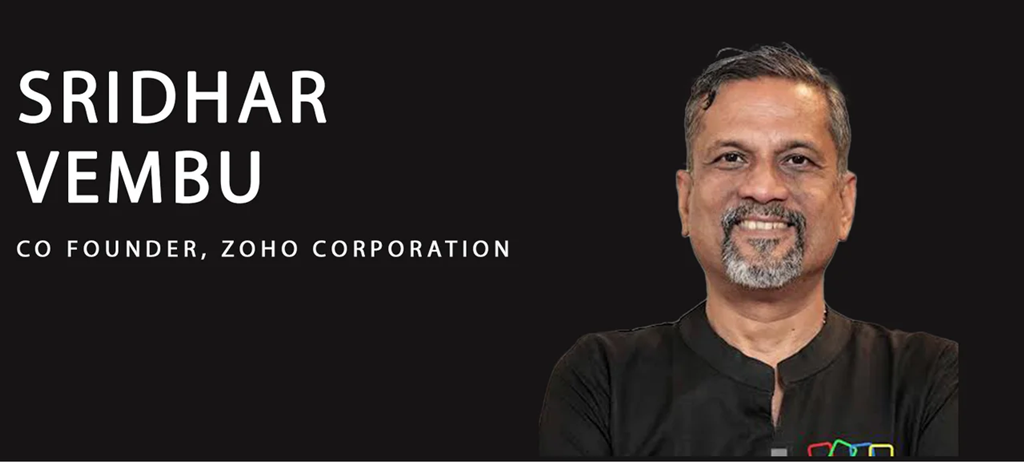
Sridhar Vembu is one of India’s most distinctive technology entrepreneurs. As the co-founder of Zoho Corporation, he helped build a global software business while following a path that differed significantly from the traditional Silicon Valley startup model. Instead of focusing primarily on venture capital, rapid expansion and an early public listing, Vembu emphasized profitability, long-term research, employee development and independence.
His journey from an engineering graduate to the creator of one of India’s best-known software companies has made him an important figure in the country’s technology and entrepreneurship landscape.
Who Is Sridhar Vembu?
Sridhar Vembu is an Indian entrepreneur, technologist and co-founder of Zoho Corporation. He studied electrical engineering at IIT Madras before completing a master’s degree and PhD at Princeton University. After working at Qualcomm in the United States, he returned to entrepreneurship and co-founded AdventNet in 1996, the company that eventually became Zoho Corporation. (Anant National University)
Vembu served as Zoho’s CEO for many years. In 2025, he moved from the CEO position to the role of Chief Scientist, allowing him to concentrate more heavily on research and development, including areas such as artificial intelligence. (Anant National University)
His career is notable not simply because of Zoho’s commercial success, but because of the philosophy behind the company.
The Beginning of Zoho
Zoho’s story began in the mid-1990s when Vembu and his co-founders established AdventNet. The company initially focused on network management software and gradually expanded its product portfolio.
Rather than building a business around a single popular product, the company developed a broad range of software tools for businesses. Over time, its products expanded into customer relationship management, finance, human resources, collaboration, productivity and other business functions.
The Zoho brand was introduced for cloud-based products in the 2000s. According to Vembu’s account of the company’s history, the business grew organically rather than following the typical venture-backed startup route. (Zoho)
This approach gave the company considerable control over its strategy.
Building a Technology Company Without Venture Capital
One of Sridhar Vembu’s most discussed business decisions has been Zoho’s choice to remain privately held and avoid conventional venture-capital dependence.
Zoho describes its philosophy as focusing on people and products while investing heavily in research and development. The company has also emphasized its decision not to pursue venture capital, an IPO or an acquisition as the foundation of its growth strategy. (Zoho)
This model provides a different perspective on entrepreneurship.
Many startups seek outside investment to grow as quickly as possible. Vembu has instead promoted the idea that a technology company can grow patiently by creating useful products, earning revenue and reinvesting in the business.
That approach can be difficult because it requires discipline and patience. However, it can also allow founders to make long-term decisions without constantly responding to investor expectations.
His Education and Technical Background
Vembu’s academic background played an important role in shaping his approach to technology.
He studied electrical engineering at IIT Madras and later completed advanced studies at Princeton University. His technical education provided a strong foundation for understanding engineering and research.
After Princeton, he worked at Qualcomm in the United States. His experience in the American technology industry exposed him to a highly developed software and engineering ecosystem.
However, rather than permanently remaining in the United States, he eventually returned to India and helped establish a technology company that would grow into a global software business. (Anant National University)
The Zoho Philosophy
One of the most interesting aspects of Sridhar Vembu’s career is his belief that software development should be treated as a long-term craft.
Zoho’s official philosophy emphasizes small teams, creativity, continuous improvement and product quality. The company argues that excessive focus on numerical metrics can sometimes damage creativity and innovation. (Zoho)
This philosophy is visible in several areas:
- Long-term product development
- Investment in research and development
- Employee training
- Internal technology development
- Customer-focused products
- Financial independence
- Reduced dependence on short-term market pressure
Vembu’s approach suggests that building a technology company is not necessarily a race to achieve the highest valuation. Instead, he has emphasized creating products that remain useful for many years.
Rural Development and Technology
Perhaps the most unusual part of Sridhar Vembu’s philosophy is his interest in rural development.
Vembu has argued that talented people should not necessarily have to migrate to major cities to find meaningful technology careers. Zoho has experimented with developing operations and employment opportunities outside India’s largest technology hubs. (Zoho)
The company’s rural-development philosophy is based on the idea that technology can distribute opportunities more widely.
Cloud computing makes it possible for employees to collaborate across locations. This can potentially allow businesses to establish offices or development centers in smaller communities while still serving customers around the world.
For Vembu, rural development and technological development are closely connected.
He has written about the importance of combining Research and Development (R&D) with Rural Development, arguing that India’s economic challenges cannot always be solved simply by importing solutions from other countries. (Zoho)
Education and Employee Development
Another important part of the Zoho model is its approach to education.
Zoho has historically emphasized practical training and developing talent internally. This philosophy challenges the assumption that every technology employee must follow a conventional university-to-corporate career path.
The company’s educational initiatives have aimed to identify talented young people and provide them with practical technology skills.
This approach has broader significance for India because the country has a huge young population but also faces challenges related to employability and access to high-quality education.
Vembu’s model attempts to connect education directly with real-world work.
Sridhar Vembu and Artificial Intelligence
Artificial intelligence has become an increasingly important part of Vembu’s thinking about the future of technology.
His decision to move into the Chief Scientist role in 2025 reflected his interest in research and long-term technology development. (Anant National University)
In August 2026, Vembu also publicly raised concerns about AI’s possible impact on employment. He questioned whether increasing software productivity through AI would necessarily lead to proportional increases in software jobs, particularly in an already competitive global software market. He argued that India needs to think seriously about job creation as AI changes the technology industry. (The Times of India)
These concerns are particularly relevant for India because the IT sector has traditionally provided employment opportunities for millions of skilled workers.
Vembu’s position highlights an important question: if machines can produce more software with fewer people, how should economies create meaningful employment for growing populations?
His Views on Young People and Work
Vembu has also spoken about work ethic, saving and simplicity.
In August 2026, he highlighted examples of young Zoho employees who demonstrated financial responsibility and a strong work ethic. His broader point was that qualities such as discipline and simplicity should not automatically be associated with one particular generation. (The Economic Times)
This reflects a broader theme in his business philosophy: personal development and long-term thinking can be more important than chasing short-term trends.
Recognition and Influence
Sridhar Vembu has received significant recognition for his contribution to Indian technology and entrepreneurship. He was awarded the Padma Shri in 2021, one of India’s prominent civilian honors. (The Indian Sun)
His influence extends beyond Zoho. Entrepreneurs and technology professionals often discuss his approach because it provides an alternative to the conventional startup formula.
His ideas around bootstrapping, rural employment, technology independence and education have also contributed to wider discussions about how India can build globally competitive technology companies.
Why Sridhar Vembu’s Story Matters
The story of Sridhar Vembu is important because it demonstrates that there is no single formula for building a successful technology company.
His journey combines several seemingly different ideas:
Global technology with local roots: Zoho serves customers internationally while investing in talent outside major technology hubs.
Business growth with independence: The company has emphasized organic growth rather than making outside funding the central driver of its strategy.
Technology with education: Training and employee development have been treated as important parts of building the workforce.
Research with commercial products: Vembu has consistently emphasized the importance of long-term R&D.
Urban technology with rural development: His vision challenges the idea that innovation must always be concentrated in major cities.
Conclusion
Sridhar Vembu represents a different model of Indian entrepreneurship. His success with Zoho demonstrates that a technology company can pursue global markets while maintaining a strong focus on long-term product development, employee training and financial independence.
His ideas about rural development are equally significant. By promoting technology jobs outside major metropolitan areas, he has challenged the traditional assumption that talented professionals must move to large cities to build successful careers.
As artificial intelligence transforms the software industry, Vembu’s move toward research and his concerns about the future of employment have added another dimension to his career.
Whether one agrees with all of his views or not, his journey offers valuable lessons about patience, independent thinking, technology, education and entrepreneurship. For aspiring founders in India and elsewhere, the Sridhar Vembu story demonstrates that building a global technology business does not necessarily require following the conventional startup playbook.
The central lesson may be simple: long-term thinking, technical capability and a willingness to challenge established business models can create an alternative path to success.