
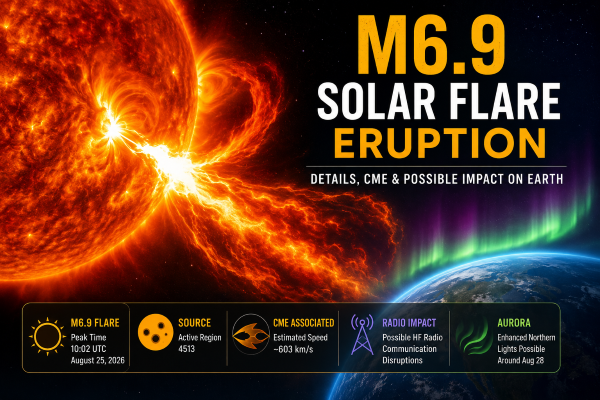
The Sun produced a powerful M6.9-class solar flare on August 25, 2026, drawing attention from space-weather researchers and skywatchers. The eruption came from Active Region 4513, a highly active sunspot region that produced several M-class flares during the same period. The event was also associated with a coronal mass ejection (CME), raising interest in the possibility of enhanced auroras and geomagnetic activity around Earth.
Here is a detailed look at what happened, what an M6.9 flare means, and what effects it could have on Earth.
What Is an M6.9 Solar Flare?
A solar flare is a sudden release of enormous energy from the Sun’s atmosphere. It happens when magnetic fields around active sunspot regions become unstable and reconnect, releasing energy as radiation.
Scientists classify solar flares according to their peak X-ray intensity. The main categories are A, B, C, M and X, with each category representing a tenfold increase in intensity compared with the previous class. The number following the letter indicates the flare’s strength within that category.
An M6.9 flare, therefore, is a substantial event. It is stronger than an M1 flare but remains below the X-class threshold, which represents the most powerful category of commonly classified solar flares.
The M6.9 event on August 25 reached a peak X-ray intensity of approximately 6.9 × 10⁻⁵ watts per square metre in the classification system used for solar flares.
When Did the M6.9 Eruption Occur?
According to a NOAA Space Weather Prediction Center daily summary, the M6.9 flare peaked at approximately 10:02 UTC on August 25, 2026. Active Region 4513 was responsible for five M-class flares during the reporting period, showing that the region was particularly energetic.
The region was positioned near the central portion of the visible solar disk, making the event especially interesting from an Earth-impact perspective. When an active region is facing Earth, eruptions from it have a greater possibility of sending a CME in our direction.
Reports also described the flare as approximately M6.98, reflecting the more precise measured value behind the rounded M6.9 designation.
Active Region 4513 Behind the Eruption
The source of the eruption was Active Region 4513, an area containing strong and complicated magnetic fields.
Sunspots appear darker than their surroundings because they are cooler than the nearby solar surface. However, beneath their relatively dark appearance are extremely powerful magnetic fields.
When magnetic field lines become twisted or rearranged, enormous amounts of stored magnetic energy can suddenly be released. This process can produce solar flares, eruptions of plasma and, in some circumstances, CMEs.
NOAA described Region 4513 as having a mixed-polarity magnetic configuration and noted its repeated M-class activity.
The Flare Was Associated With a CME
One of the most important aspects of the August 25 eruption was its association with a coronal mass ejection.
A CME is a huge cloud of magnetized plasma expelled from the Sun’s outer atmosphere. Unlike a solar flare, which primarily sends electromagnetic radiation outward at the speed of light, a CME travels through interplanetary space and can take much longer to reach Earth.
The NOAA report also recorded a Type II radio sweep, with an estimated speed of about 603 km/s, providing evidence of shock-related activity associated with the eruption.
Initial modelling indicated that the CME could potentially give Earth a glancing blow around August 28, although the exact arrival time and strength can change as additional observations become available.
Could the CME Cause Northern Lights?
One of the most exciting possible consequences is an increase in aurora activity.
Auroras occur when energetic particles associated with solar activity interact with Earth’s magnetic field and upper atmosphere. During geomagnetic disturbances, auroras can sometimes become visible much farther from the polar regions than normal.
If the August 25 CME interacts strongly enough with Earth’s magnetic field, skywatchers in some higher-latitude regions could have an opportunity to see enhanced northern or southern lights.
However, an M6.9 flare does not automatically mean a major aurora display. The actual effect depends heavily on the CME’s direction, speed, magnetic structure and how its magnetic field interacts with Earth’s magnetosphere.
Possible Effects on Radio Communications
Solar flares can have immediate effects on Earth’s ionosphere because they release intense electromagnetic radiation.
The strongest impacts generally occur on the sunlit side of Earth. High-frequency radio communications can experience disruptions, particularly in regions affected by the flare’s radiation.
NOAA explains that solar flares can produce radio blackouts and that their effects can extend to systems that depend on the ionosphere, including certain communication and navigation services.
The August 25 event was accompanied by a significant radio burst, and monitoring of possible space-weather effects continued after the eruption.
Is the M6.9 Flare Dangerous for People on Earth?
For people on the ground, an M6.9 solar flare itself is not generally a direct physical danger. Earth’s atmosphere and magnetic field provide substantial protection from much of the Sun’s harmful radiation.
The bigger concerns involve technology.
Strong solar activity can affect:
- High-frequency radio communications
- Satellite operations
- GPS and other navigation systems
- Aviation communications
- Spacecraft electronics
- Electrical infrastructure during sufficiently strong geomagnetic storms
NOAA’s space-weather scales distinguish between radio blackouts, solar radiation storms and geomagnetic storms because these phenomena have different causes and effects.
Why Scientists Are Watching the Sun Closely
Solar activity changes over an approximately 11-year cycle. During active phases, sunspots and powerful eruptions become more common.
The repeated M-class eruptions from Region 4513 demonstrate why scientists continuously monitor the Sun using satellites and ground-based observatories.
Space-weather forecasting is particularly important because modern society depends heavily on satellites, communications, navigation and electrical infrastructure. Early warnings allow satellite operators, airlines and other organizations to prepare for potentially disruptive conditions.
Final Thoughts
The M6.9 solar flare of August 25, 2026 was a significant solar eruption originating from the highly active sunspot region 4513. It peaked around 10:02 UTC, produced a strong radio signature and was associated with a CME that could potentially pass near Earth around August 28.
The event highlights the constantly changing nature of our Sun. While an M6.9 flare is unlikely to directly harm people on Earth’s surface, its radiation and associated CME can influence technology and space weather. For skywatchers, the most interesting possibility is enhanced auroral activity if the CME interacts favorably with Earth’s magnetic field.
Note: Solar-weather forecasts can change as new satellite observations become available, so the expected CME arrival time and geomagnetic impact should be checked against the latest official space-weather updates.



2 thoughts on “M6.9 Solar Flare Eruption: Details, Causes, CME and Possible Impact on Earth”