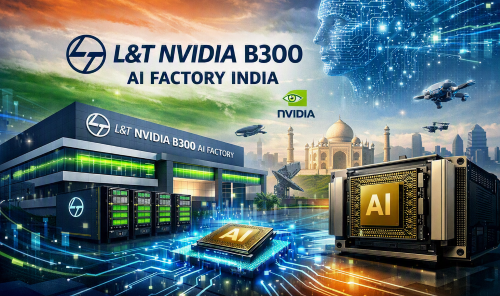
L&T NVIDIA B300 AI Factory: Artificial intelligence is moving from experimental projects to large-scale infrastructure, and India is becoming an increasingly important destination for AI computing. One of the biggest developments in this space is Larsen & Toubro’s (L&T) plan to build an NVIDIA B300-powered AI Factory in Chennai.
On August 13, 2026, L&T announced that its AI infrastructure subsidiary, LTN Compute, had secured a major order from US-based AI cloud company Together AI. The project will create what L&T describes as India’s largest single-cluster AI infrastructure facility, with capacity for 10,000 NVIDIA B300 GPUs.
The project is important not only because of its size, but also because it shows how India is building infrastructure capable of supporting advanced AI models, AI agents, enterprise applications and large-scale computing.
What Is the L&T NVIDIA B300 AI Factory?
An AI Factory is different from a conventional data centre. A traditional data centre primarily provides computing, storage and networking services. An AI Factory is designed specifically around the enormous computing, networking, cooling, storage and power requirements of artificial intelligence.
L&T’s new AI Factory will be hosted at the Vyoma.AI Chennai data centre campus and will have a capacity of 10,000 NVIDIA B300 GPUs. The facility is being developed for Together AI, an AI cloud company that provides infrastructure for AI developers and businesses. (L&T Corporate)
The integrated system is expected to combine:
- NVIDIA B300 GPUs
- High-performance networking
- Ultra-low-latency interconnects
- High-throughput storage
- AI infrastructure management
- Large-scale data-centre facilities
- Computing infrastructure for AI training and inference
Together, these components are intended to create an infrastructure platform capable of handling demanding AI workloads.
How Did L&T Get Into AI Infrastructure?
The latest B300 project did not appear suddenly. It is part of a broader strategy by L&T to expand from traditional engineering and infrastructure into digital infrastructure and AI.
A major step came in February 2026, when L&T announced a proposed venture with NVIDIA to develop sovereign, scalable, gigawatt-scale AI Factory infrastructure in India.
The announcement was made during the India AI Summit. L&T said the proposed venture would combine its engineering and infrastructure capabilities with NVIDIA’s computing, networking and software technologies. (L&T Corporate)
The objective was broader than simply installing GPUs. L&T wanted to establish AI-ready infrastructure that could serve Indian businesses, global cloud providers, hyperscalers and other customers.
The February plan included scaling NVIDIA GPU infrastructure at L&T’s Chennai data centre campus and developing a new data centre in Mumbai. L&T said the Chennai campus could scale toward 30 MW of AI computing capacity, while the Mumbai facility was planned at 40 MW. (L&T Corporate)
That earlier announcement provides the background for the much larger B300 deployment announced in August.
What Is NVIDIA B300?
The NVIDIA B300 belongs to NVIDIA’s Blackwell Ultra generation of AI accelerators.
These processors are designed for demanding workloads such as:
- Large language model training
- AI inference
- Fine-tuning
- Generative AI
- Scientific computing
- AI agents
- Enterprise AI applications
Modern AI systems require enormous amounts of computing power. Training and operating increasingly sophisticated models can require thousands of GPUs working together.
That is why the infrastructure around the GPU is just as important as the GPU itself. Networking, storage, cooling, electricity and software must work together efficiently.
L&T says its AI Factory will integrate these elements into a unified infrastructure stack rather than treating the GPUs as isolated computing equipment. (L&T Corporate)
Why 10,000 GPUs Is Significant
The planned 10,000-GPU capacity makes the project particularly significant for India’s AI ecosystem.
For comparison, a small AI development environment might use a handful of GPUs, while research laboratories and cloud providers can operate clusters containing hundreds or thousands of accelerators.
A 10,000-GPU cluster is designed for a completely different scale of operation.
It can potentially support multiple large AI workloads simultaneously, including model training, inference and fine-tuning.
According to L&T, the facility is intended to support Together AI’s AI-native cloud platform and large-scale workloads. (L&T Corporate)
This could give AI companies access to high-end computing capacity without requiring them to build their own massive data centres.
The ₹10,000-15,000 Crore Question
One of the most widely reported aspects of the announcement is the size of the order.
L&T classified the project as a “Mega” order. Under the company’s classification system, that category represents an order value between ₹10,000 crore and ₹15,000 crore.
However, L&T has not publicly disclosed the exact contract value. Therefore, it is more accurate to describe the project as being in the ₹10,000-15,000 crore order category rather than claiming that the exact contract is worth ₹10,000 crore or ₹15,000 crore. (NDTV)
Reuters separately reported that the contract could be worth up to about ₹150 billion ($1.57 billion). (Reuters)
Chennai: The Location of India’s New AI Infrastructure Push
The AI Factory will be hosted at the Vyoma.AI Chennai data centre campus.
The campus is planned as a gigawatt-scale AI infrastructure site. According to L&T, Phase 1 has been designed for 250 MW, with power infrastructure readiness of 150 MVA. (L&T Corporate)
This is important because AI data centres consume substantially more power and generate more heat than conventional computing facilities.
A large GPU cluster therefore requires sophisticated power distribution, cooling systems, networking and physical infrastructure.
This is an area where L&T’s traditional engineering experience can become an important advantage.
What Will the AI Factory Be Used For?
The facility is expected to support three major categories of AI workloads.
1. AI Training
Training an advanced AI model requires processing enormous quantities of data. Thousands of GPUs can work together to reduce the time needed for computationally intensive training.
2. AI Fine-Tuning
Companies can adapt existing AI models for specific industries and applications through fine-tuning.
For example, businesses may want models designed for finance, manufacturing, healthcare, customer service or engineering.
3. AI Inference
Inference happens when an AI model responds to users or applications.
As generative AI becomes part of everyday software, demand for inference computing is expected to grow significantly.
The L&T facility is designed to support all three workloads. (L&T Corporate)
India’s Push Toward Sovereign AI
Another important theme behind L&T and NVIDIA’s strategy is sovereign AI infrastructure.
Sovereign AI generally means having the ability to develop, train and operate AI systems using infrastructure located within a particular country and under its applicable rules and controls.
In February, L&T said its proposed AI Factory infrastructure would allow critical data, AI models and workloads to be built and deployed within India while remaining connected to global ecosystems. (L&T Corporate)
This could become increasingly important for industries handling sensitive information.
Financial institutions, healthcare companies, government organisations, manufacturers and infrastructure operators may prefer computing environments that provide greater control over where data and AI workloads are processed.
L&T’s Broader AI Strategy
The B300 project also represents a change in L&T’s technology ambitions.
L&T is traditionally associated with engineering, construction, infrastructure, energy and industrial projects. AI infrastructure gives the company an opportunity to participate in a rapidly expanding technology market.
The company’s strategy is not limited to constructing buildings for data centres. Its stated AI Factory model combines physical infrastructure with computing, networking, storage and AI software.
L&T has also been exploring secure AI infrastructure. In July 2026, L&T Vyoma announced a partnership with Fortanix involving confidential computing and NVIDIA technology, aimed at protecting data while it is being processed. (L&T Corporate)
What This Means for India’s AI Future
The L&T-NVIDIA development comes at a time when India is attempting to expand its domestic AI computing capacity.
NVIDIA has identified L&T, along with other Indian infrastructure and cloud companies, as partners in expanding AI infrastructure under the broader IndiaAI ecosystem. NVIDIA has said India’s AI cloud infrastructure will support model training, fine-tuning and inference for startups, researchers, enterprises and other users. (NVIDIA Blog)
This means the Chennai AI Factory could become part of a larger network of AI computing infrastructure across India.
The impact could extend beyond technology companies. Industries such as manufacturing, healthcare, financial services, agriculture, logistics and energy can increasingly use AI for automation, prediction, optimisation and decision-making.
Challenges Ahead
Building a 10,000-GPU AI Factory is not simply a matter of buying processors and installing them.
The project will have to deal with enormous requirements for:
- Electricity
- Cooling
- Networking
- Hardware maintenance
- Data security
- Storage
- Skilled technical staff
- Operational reliability
Power efficiency will also be critical. AI infrastructure can consume significant amounts of electricity, making energy management an important part of future data-centre development.
Another challenge will be ensuring that expensive GPU capacity is used efficiently. AI workloads can change quickly, so cloud infrastructure needs sophisticated scheduling and resource management.
The Future of the L&T NVIDIA AI Factory
The latest announcement is best viewed as one stage in L&T’s larger AI infrastructure strategy rather than an isolated project.
In February 2026, L&T announced its ambition to develop gigawatt-scale AI infrastructure with NVIDIA. In August, that strategy moved closer to a concrete large-scale deployment through the 10,000-GPU B300 AI Factory for Together AI. (L&T Corporate)
If successfully deployed and expanded, the Chennai facility could strengthen India’s position as a destination for AI computing.
It could also help Indian and international companies access advanced computing resources without building their own GPU clusters.
Conclusion
The L&T NVIDIA B300 AI Factory is one of the most significant AI infrastructure announcements in India in 2026. With capacity for 10,000 NVIDIA B300 GPUs, the Chennai facility represents a major move toward industrial-scale AI computing.
Its history began with L&T’s broader February 2026 partnership plans with NVIDIA for sovereign, gigawatt-scale AI infrastructure. The August 2026 announcement shows how that strategy is developing into a large commercial deployment for Together AI.
The bigger story is not simply about 10,000 GPUs. It is about India’s attempt to build the infrastructure needed for the next generation of artificial intelligence.
As AI moves from chatbots and experiments into manufacturing, healthcare, finance, government and other critical industries, facilities such as L&T’s Chennai AI Factory could become an important part of India’s digital infrastructure.
For L&T, the project marks an important expansion into AI Factories. For NVIDIA, it strengthens its role in India’s growing AI ecosystem. And for India, it represents another step toward becoming a serious global hub for large-scale AI development and deployment.