
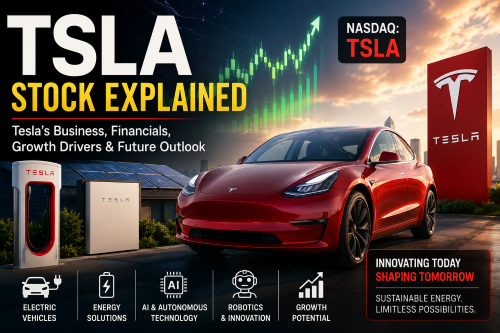
Tesla Inc. (NASDAQ: TSLA), commonly referred to by its stock ticker TSLA, is one of the world’s most recognized technology and automotive companies. Founded with the vision of accelerating the world’s transition to sustainable energy, Tesla has transformed from a niche electric vehicle (EV) manufacturer into a global leader in clean transportation, battery technology, artificial intelligence, robotics, and renewable energy.
TSLA stock attracts millions of investors because Tesla is much more than a car company. Its innovations span electric vehicles, autonomous driving software, battery manufacturing, solar energy products, energy storage systems, and even humanoid robotics. This diverse portfolio has positioned Tesla among the most influential technology companies globally.
What Is TSLA?
TSLA is the stock ticker symbol for Tesla Inc., listed on the NASDAQ stock exchange.
Investors buy TSLA shares to own a small portion of Tesla and participate in the company’s future growth.
Tesla has become one of the most actively traded stocks worldwide due to:
- Leadership in electric vehicles
- Strong revenue growth
- Continuous innovation
- Artificial intelligence initiatives
- Autonomous driving technology
- Global manufacturing expansion
- Renewable energy business
Its stock often experiences significant price movements, making it popular among both long-term investors and active traders.
The History of Tesla
Tesla was founded in 2003 by engineers Martin Eberhard and Marc Tarpenning. Later, Elon Musk joined the company as an early investor and eventually became CEO.
Tesla’s mission has remained consistent:
Accelerate the world’s transition to sustainable energy.
The company launched several groundbreaking products over the years:
- Tesla Roadster
- Model S
- Model X
- Model 3
- Model Y
- Cybertruck
- Tesla Semi
Beyond vehicles, Tesla expanded into:
- Solar panels
- Solar roofs
- Battery storage
- AI software
- Robotics
Today, Tesla operates multiple Gigafactories across different countries to meet growing global demand.
Tesla’s Core Business Segments
Tesla generates revenue from several major business areas.
1. Electric Vehicles
Vehicle sales remain Tesla’s largest revenue source.
Popular models include:
- Model 3
- Model Y
- Model S
- Model X
- Cybertruck
Tesla vehicles are known for:
- Long driving range
- Fast acceleration
- Advanced software
- Over-the-air updates
- High safety ratings
2. Energy Generation and Storage
Tesla develops renewable energy products such as:
- Solar Panels
- Solar Roof
- Powerwall
- Powerpack
- Megapack
These products help homeowners, businesses, and utilities store renewable electricity efficiently.
The energy business has become an increasingly important contributor to Tesla’s long-term growth strategy.
3. Software and Services
Tesla earns recurring revenue through software offerings including:
- Full Self-Driving (FSD)
- Premium Connectivity
- Vehicle servicing
- Insurance
- Charging services
Software generates attractive profit margins because digital products have relatively low incremental costs after development.
4. Artificial Intelligence
Tesla invests heavily in AI through:
- Self-driving algorithms
- Neural networks
- Computer vision
- AI chips
- Dojo supercomputer
The company’s AI systems process billions of miles of driving data to improve autonomous capabilities.
5. Robotics
Tesla introduced Optimus, a humanoid robot designed to perform repetitive and potentially hazardous tasks.
While still in development, robotics represents a potential long-term business opportunity.
Tesla’s Revenue Model
Tesla earns money from several sources:
- Vehicle sales
- Leasing
- Software subscriptions
- Charging network
- Insurance
- Energy storage
- Solar installations
- Carbon regulatory credits
- Vehicle servicing
This diversified model helps reduce reliance on any single revenue stream.
Why Investors Like TSLA
Strong Brand Recognition
Tesla is among the most valuable automotive brands globally.
Customers associate Tesla with:
- Innovation
- Sustainability
- Performance
- Technology
Strong brand loyalty supports continued demand.
Industry Leadership
Tesla remains one of the largest EV manufacturers in the world.
Its advantages include:
- Battery expertise
- Manufacturing scale
- Global charging infrastructure
- Vertical integration
- Advanced software
Continuous Innovation
Tesla frequently introduces improvements through software updates without requiring customers to purchase a new vehicle.
Innovation extends to:
- Battery chemistry
- Manufacturing automation
- AI
- Robotics
- Energy storage
Large Addressable Market
Tesla operates across multiple rapidly growing industries:
- Electric vehicles
- Renewable energy
- AI
- Autonomous driving
- Robotics
Each market offers significant long-term growth potential.
Tesla’s Competitive Advantages
Several factors differentiate Tesla from competitors.
Battery Technology
Tesla continues improving battery efficiency, charging speed, durability, and manufacturing costs.
Lower battery costs can improve profitability while making EVs more affordable.
Supercharger Network
Tesla operates one of the world’s largest fast-charging networks.
Benefits include:
- Convenience
- Reliability
- Faster travel
- Better customer experience
Software Integration
Unlike many traditional automakers, Tesla designs much of its software in-house.
Advantages include:
- Faster updates
- Better optimization
- Enhanced security
- Continuous feature improvements
Manufacturing Efficiency
Tesla pioneered several manufacturing innovations:
- Gigafactories
- Large casting technology
- Automated production
- Vertical integration
These improvements aim to reduce production costs and increase output.
Tesla’s Artificial Intelligence Strategy
AI has become one of Tesla’s most significant investment areas.
The company develops AI for:
- Autonomous driving
- Robotics
- Manufacturing
- Quality control
- Fleet learning
Tesla collects vast amounts of real-world driving data that help train its neural networks.
This data-driven approach distinguishes Tesla from many competitors.
Energy Business Growth
Tesla’s energy division continues expanding.
Products include:
Powerwall
Residential battery storage.
Megapack
Large-scale utility energy storage.
Solar Roof
Roof tiles integrated with solar generation.
Growing renewable energy adoption may support long-term demand for these products.
Risks Facing TSLA Stock
Despite its strengths, Tesla faces several challenges.
Increasing Competition
Major automakers continue launching electric vehicles, increasing competition across global markets.
Economic Slowdowns
Higher interest rates and weaker consumer spending can reduce vehicle demand.
Supply Chain Challenges
Battery materials such as lithium, nickel, and graphite remain critical inputs.
Price volatility can affect production costs.
Regulatory Changes
Government policies regarding:
- EV incentives
- Safety standards
- Autonomous driving
- Environmental regulations
can significantly impact Tesla’s business.
Stock Volatility
TSLA is known for substantial price fluctuations.
Investors should expect periods of significant volatility.
Factors That Could Drive Future Growth
Several catalysts may support Tesla’s long-term expansion.
Expanded Vehicle Production
New manufacturing capacity can increase deliveries worldwide.
Autonomous Driving
If autonomous technology reaches broader commercial deployment, software revenue could become a larger contributor to Tesla’s business.
Robotaxis
Tesla has discussed the potential for autonomous ride-hailing services, which could open a new revenue stream if supported by technology and regulatory approval.
Energy Storage
Demand for grid-scale batteries continues growing as renewable energy adoption increases.
Megapack installations represent a promising business segment.
Robotics
Optimus could eventually support industrial automation if successfully commercialized.
Tesla’s Global Presence
Tesla sells products across many international markets.
Major manufacturing facilities are located in:
- United States
- China
- Germany
These factories help reduce shipping costs while serving regional demand more efficiently.
Sustainability Initiatives
Tesla emphasizes sustainability throughout its operations.
Examples include:
- Zero-emission vehicles
- Renewable energy products
- Battery recycling initiatives
- Energy-efficient manufacturing
- Solar power integration
Its mission aligns with global efforts to reduce greenhouse gas emissions.
Who Invests in TSLA?
TSLA attracts a broad range of investors:
- Retail investors
- Mutual funds
- Pension funds
- Hedge funds
- Exchange-traded funds (ETFs)
- Institutional asset managers
Its inclusion in major market indexes has also increased institutional ownership.
Is TSLA a Technology Company or an Automaker?
This remains one of the most debated questions among investors.
Tesla combines characteristics of both sectors.
Reasons it resembles a technology company include:
- AI development
- Proprietary software
- Autonomous driving research
- Robotics
- Cloud-connected vehicles
- Continuous software updates
Reasons it resembles an automaker include:
- Vehicle manufacturing
- Global factories
- Automotive supply chains
- Vehicle sales and servicing
Many analysts describe Tesla as a technology-driven mobility and energy company rather than a traditional automaker.
Key Metrics Investors Watch
When evaluating TSLA, investors commonly monitor:
- Vehicle deliveries
- Revenue growth
- Gross margin
- Operating margin
- Free cash flow
- Earnings per share (EPS)
- Research and development spending
- Energy storage deployments
- Automotive gross margins
- Cash reserves
These metrics help assess Tesla’s operational performance and financial health over time.
Tips for New TSLA Investors
If you’re considering investing in TSLA, keep these principles in mind:
- Understand Tesla’s business beyond vehicle sales.
- Be prepared for stock price volatility.
- Focus on long-term trends rather than short-term market movements.
- Review financial statements and quarterly earnings reports.
- Diversify your investments instead of relying on a single stock.
- Consider your own financial goals, risk tolerance, and investment horizon before making investment decisions.
Frequently Asked Questions
What does TSLA stand for?
TSLA is the NASDAQ ticker symbol for Tesla Inc.
Is Tesla only an electric vehicle company?
No. Tesla also operates in energy storage, solar energy, software, artificial intelligence, charging infrastructure, and robotics.
Why is TSLA stock so volatile?
Its price is influenced by earnings reports, vehicle deliveries, competition, macroeconomic conditions, interest rates, product announcements, and investor expectations about future growth.
Does Tesla make money from software?
Yes. Tesla generates revenue from software features, connectivity services, insurance, charging, and other recurring offerings in addition to vehicle sales.
Is TSLA suitable for long-term investors?
Some investors view TSLA as a long-term growth company due to its exposure to electric vehicles, AI, and renewable energy. However, like any investment, it carries risks and there is no guarantee of future returns.
Conclusion
TSLA has evolved far beyond its origins as an electric vehicle manufacturer. Today, Tesla operates at the intersection of automotive engineering, artificial intelligence, renewable energy, battery technology, software, and robotics. This diversified approach has helped make it one of the world’s most closely watched companies.
The company’s long-term success will depend on its ability to continue innovating, scale manufacturing efficiently, navigate increasing competition, and execute on ambitious initiatives such as autonomous driving, energy storage, and robotics. While TSLA stock can experience significant volatility, many investors continue to follow it closely because of its potential exposure to several high-growth industries.
Whether you’re researching Tesla for investment purposes or simply seeking to understand one of the world’s most influential technology companies, it’s important to evaluate both the opportunities and the risks. A balanced, well-informed perspective—and regular review of Tesla’s financial results, strategic developments, and broader market conditions—can help you make more confident decisions.