Moving abroad to join your family is one of the biggest steps you will ever take. Whether you are sponsoring your child, parent, or sibling for a visa, embassies want solid proof that you truly share a family bond. Sometimes your birth certificate or other papers are not enough to convince the officers handling your case. That is when immigration DNA tests in Panipat come in handy. These tests give you clear, dependable proof of your biological connection, so your visa application doesn’t get rejected or stay pending. This guide walks you through why you may need this test, what to bring, and how the whole process works from start to finish.
Why Your Sponsored Visa Application May Need a DNA Test
You may think that the provided visa documents would be enough for the embassy. But in some cases, documents may be suspected by the embassy. Therefore, to ensure the family link between the sponsor and applicant, a DNA test is requested.
Here are some common reasons you could be asked for a DNA test:
- Your birth certificate was never made or has been lost over the years
- Names or dates do not match across your different documents
- Your birth was registered long after you were actually born
- The officer suspects your paperwork may not be genuine
When any of these situations come up, DNA tests in Panipat step in to help many applicants in Haryana. A DNA report leaves little room for argument, since it shows your biological link in black and white.
What Documents You Should Carry to Your Appointment
Since this is a legal process, you cannot simply walk into the lab without the right paperwork in hand. Make sure you carry these items on the day of your test:
- Your original passport, along with one clear photocopy
- A second government-issued photo ID, such as your Aadhaar card or driving license
- Two recent passport-size photographs for every person being tested
- Your immigration case reference number or the request letter from your embassy
Having these items ready ahead of time saves you a return trip and keeps your appointment moving smoothly.
Types of Family Relationships Verified
Your family situation decides which test fits your case. Depending on who is sponsoring whom, you may be asked for one of these:
- Paternity – checks the link between a father and his child
- Maternity – confirms the bond between a mother and her child
- Siblingship – shows whether two people share the same parents
- Grandparentage – used when a grandparent is sponsoring a grandchild
- Avuncular – confirms the tie between an aunt or uncle and a niece or nephew
Whichever category matches your situation, immigration DNA tests in Panipat can be arranged around your family’s exact needs, even if your relatives live in a different country.
How the Sample Collection Works
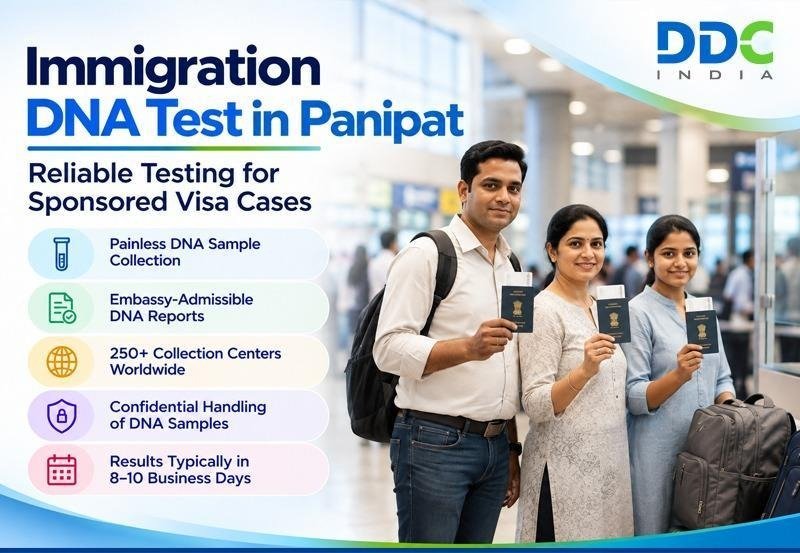
You do not need to worry about needles or blood draws during your visit. A trained lab staff member simply rubs a soft swab against the inside of your cheek for a few seconds. This picks up cells from the lining of your mouth, and it does not hurt at all. The method is gentle enough for your elderly relatives and safe even for a newborn baby in your family. Once the DNA samples are collected, the lab experts seal them inside a tamper-proof package to prevent tampering and environmental contamination.
What Happens After DNA Samples Are Collected
After collecting the DNA samples, they’re transported to the lab for further examination. The experts in the lab carefully analyze and compare the DNA samples to find the potential genetic match between individuals. After completing the DNA analysis, a final report is generated, which is confidentially sent to the tested party’s address within 4-5 business days.
Understanding the Chain of Custody Procedure in Immigration DNA Tests
In some cases, the embassy may request a DNA test under a chain of custody procedure. During this process, the DNA samples are collected under the supervision of an embassy-appointed official. Before the sample collection begins, the official verifies the identities of the individuals in the DNA test using their government-issued IDs. This process is to make sure that the right persons are present during the test.
Moreover, the final report of a chain-of-custody DNA test is sent directly to the embassy instead of the tested party. It’s to protect the privacy and integrity of the final report for its official admissibility.
Why Choose DDC Laboratories India for Immigration DNA Tests in Panipat?
Not every lab can give you a report that international embassies will accept. Before you book your appointment, you should confirm that the lab holds accreditations such as AABB, NATA, and MOJ. We, at DDC Laboratories India, hold accreditations from such prestigious organizations, making our DNA reports officially admissible in international embassies. Such embassies include the United States, the United Kingdom, Canada, Australia, Poland, and other countries.
Moreover, we have more than 250 sample collection centers across the globe, making it easier for applicants to find one of our testing facilities near their locations. Reuniting with your loved ones is worth every step of this process. When your documents alone cannot convince the embassy, immigration DNA tests in Panipat give you the dependable proof you need to keep your case moving forward.
Frequently Asked Questions
Q1. How to book an immigration DNA test online in India?
Call the experts at DDC Laboratories India, share your requirements, and book a slot for your DNA collection appointment.
Q2. What documents are required for an immigration DNA test in India?
A passport, a government-issued ID, recent photographs, and a consent form are required for immigration DNA tests in India.
Q3. Can I use home collection for immigration DNA tests in India?
No. An in-home DNA sample collection report is not admissible in international embassies for the family reunification process.
Q4. Are DNA test results from Indian labs accepted by international immigration authorities?
Yes. DNA reports from labs like DDC Laboratories India are widely accepted by international immigration authorities.
Q5. How accurate are DNA tests used for immigration purposes?
Immigration DNA tests provide an accuracy of 99.99%, which is enough for the report to be admissible for official purposes.
Disclaimer
This article is for general informational purposes only and does not constitute legal, immigration, or medical advice. Immigration DNA testing requirements vary by country, visa type, and immigration authority. DNA testing may help provide evidence of a biological relationship, but it does not guarantee visa approval or a successful immigration application. Always consult the relevant immigration authority or a qualified immigration professional and use an accredited DNA testing laboratory before making decisions.