
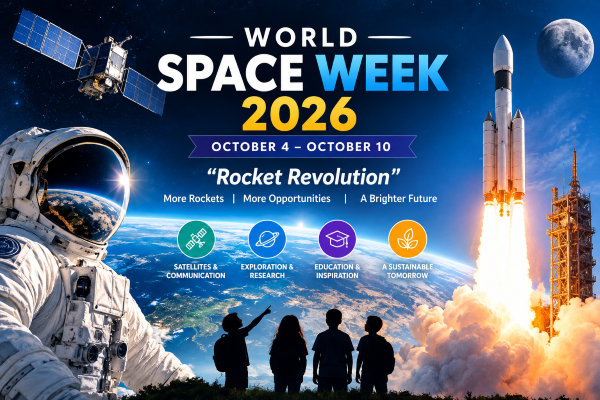
World Space Week 2026 is being celebrated from October 4 to October 10, bringing together students, scientists, educators, space organizations and astronomy enthusiasts to celebrate humanity’s achievements in space science and technology. The theme for 2026 is “Rocket Revolution,” highlighting the rapid changes taking place in rocket technology and the growing accessibility of space.
World Space Week is more than a celebration of rockets and astronauts. It is an opportunity to understand how space technology affects everyday life, encourages scientific education and supports international cooperation.
What Is World Space Week?
World Space Week is an annual international celebration dedicated to space science and technology. The United Nations General Assembly officially declared October 4–10 as World Space Week in 1999.
The two dates have special historical significance. On October 4, 1957, the Soviet Union launched Sputnik 1, the first human-made satellite to orbit Earth. On October 10, 1967, the Outer Space Treaty entered into force, establishing important principles for the peaceful exploration and use of outer space.
Today, World Space Week has become one of the world’s largest annual space outreach events.
World Space Week 2026 Theme: Rocket Revolution
The official theme of World Space Week 2026 is “Rocket Revolution.” The theme focuses on how rocket technology is changing the way humanity reaches space.
For many years, space launches were primarily controlled by a limited number of national space agencies. Today, commercial companies, startups, universities and emerging space programs are contributing to a rapidly developing launch industry. Reusable rockets and new launch technologies are helping change the economics and frequency of space missions.
The theme also encourages people to think about the future of space exploration. As launching spacecraft becomes more accessible, more organizations can potentially participate in satellite missions, scientific research, Earth observation and lunar exploration.
Why Is World Space Week Important?
Space technology has become an important part of modern society. Many technologies and services people use every day depend on satellites and space-based systems.
Satellites support:
- Weather forecasting
- Television and telecommunications
- GPS and navigation
- Disaster management
- Agriculture and environmental monitoring
- Scientific research
- Climate and Earth observation
- Internet and communication services
The United Nations also recognizes the importance of space science and technology in supporting sustainable development and international cooperation.
World Space Week helps explain these benefits to the public while encouraging young people to consider careers in science, technology, engineering and mathematics.
How Is World Space Week 2026 Being Celebrated?
World Space Week events are taking place in many countries. Schools, museums, planetariums, astronomy clubs, universities and space organizations can organize activities during the October 4–10 period.
Common activities include:
- Space science exhibitions
- Rocket demonstrations
- Astronomy workshops
- Planetarium shows
- Space-themed competitions
- Student presentations
- Model rocket projects
- Telescope observations
- Educational webinars
- Space technology discussions
The World Space Week Association reports that the celebration reaches communities across more than 100 countries, with thousands of events organized around the world.
In India, for example, the Satish Dhawan Space Centre has highlighted the 2026 celebration around the “Rocket Revolution” theme.
World Space Week and Students
One of the most important purposes of World Space Week is inspiring young people.
Space exploration naturally creates curiosity. Questions about the Moon, planets, stars, galaxies, rockets and astronauts can encourage students to learn physics, mathematics, computer science and engineering.
Schools can use World Space Week as an opportunity to organize simple educational activities. Students can build paper rockets, create solar-system models, learn about satellite technology or research famous space missions.
Such activities can demonstrate that space science is not only about becoming an astronaut. Careers in spacecraft engineering, software development, astronomy, robotics, satellite communications and data science are also connected to the space industry.
The Growing Importance of Reusable Rockets
A major part of the rocket revolution is the development of reusable launch technology.
Traditional rockets were generally designed for limited use, meaning much of the launch vehicle was discarded after a mission. Reusable systems aim to recover and fly important parts of a rocket again.
This approach can potentially reduce launch costs and increase the number of missions that can be conducted. It also supports a broader space economy involving satellites, research missions, commercial services and future exploration.
However, rocket development remains technically challenging. Engineers must solve problems involving propulsion, heat, guidance, materials, safety and recovery.
World Space Week and the Future of Space Exploration
The future of space exploration could look very different from the early Space Age.
Humanity is studying the Moon, Mars and other destinations while developing new spacecraft and launch systems. Satellites are becoming increasingly important for communication and Earth observation, while robotics and artificial intelligence are opening new possibilities for scientific exploration.
The growing participation of commercial organizations and emerging space nations could also make the space sector more diverse.
World Space Week 2026 provides a useful opportunity to discuss these developments while also considering responsible and peaceful uses of outer space.
How You Can Celebrate World Space Week 2026
Anyone can participate in World Space Week. You do not need to work for a space agency or have advanced scientific knowledge.
You can celebrate by watching educational space programs, visiting a planetarium, observing the night sky, reading about famous missions or participating in a local astronomy event.
Students can create space-themed projects, while teachers can organize classroom discussions about rockets and satellites. Families can also spend an evening learning about constellations and planets together.
Conclusion
World Space Week 2026, celebrated from October 4 to October 10, puts the spotlight on the “Rocket Revolution” and the rapidly changing world of space launches.
The celebration reminds us that space exploration is no longer limited to a small group of organizations. Advances in rockets, satellites and space technology are creating new opportunities for research, communication, education and economic development.
Most importantly, World Space Week encourages the next generation to remain curious. The rockets launched today may ultimately help create the discoveries, technologies and missions that define humanity’s future in space.