
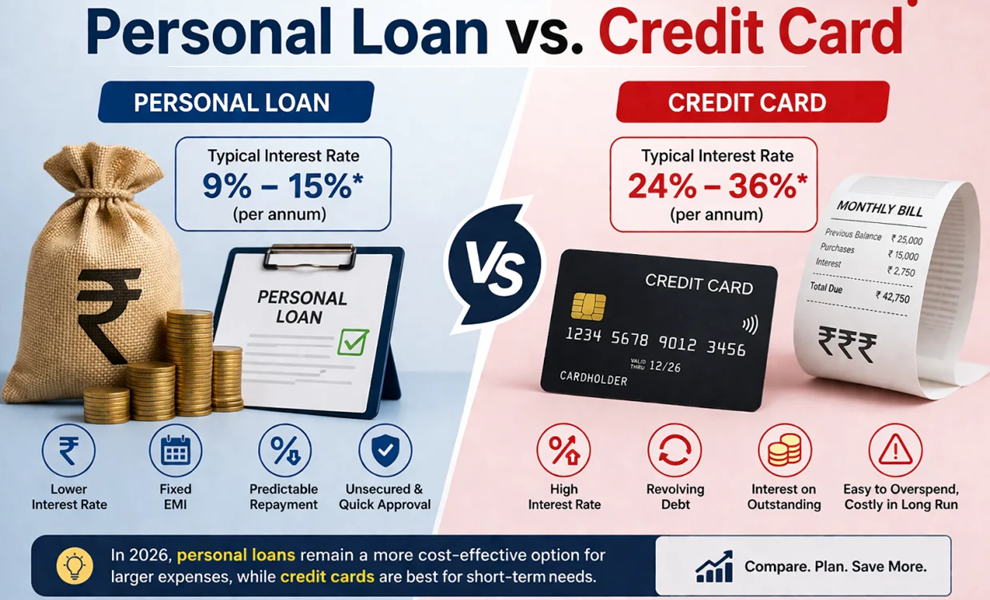
Whenever there is a financial or medical emergency, availability of easy credit becomes extremely important. For most salaried professionals, this either means a personal loan or a credit card. Both these financial instruments can help borrowers get quick access to funds. But they both work very differently in terms of eligibility, interest rates, repayment conditions, etc. Hence, comparing personal loans and credit cards can help us choose the right option with lower borrowing costs.
Why Immediate Expenses Require a Different Approach
When you are planning a big purchase or financing a planned expense, you have enough time to make an informed decision. You can compare lenders and their offers, check the estimated borrowing costs for each option, read the fine print, and take your time before applying for a loan. An emergency is different. Admitting someone in hospital immediately, arranging funds for an urgent payment, etc., can reduce the decision time to just a few hours. In such situations, two things matter the most: time taken to arrange the money, and the actual repayment costs.
How a Credit Card Works During an Emergency
If you have a credit card, you can skip the waiting process altogether. Making a purchase or cash withdrawal doesn’t take much time. The only concern is if the funds required are within the available credit limit. If there are any unpaid balances, that can complicate matters. Moreover, the interest on the unpaid balance usually goes up to 45% per annum. A cash withdrawal on a credit card costs even more. It carries a flat fee on top of interest costs.
But card limits usually don’t stretch as far as a personal loan can. An expensive medical treatment, major vehicle repair, or home renovation work would typically require sizable funds, which a credit card may not be able to offer. Once that happens, the card covers only part of the bill, and an emergency loan usually fills whatever gap remains.
How a Personal Loan Functions for Urgent Expenses
Personal loans work in a different way. An applicant applies for an emergency loan through a bank or non-banking financial company (NBFC). The lender evaluates his application based on the eligibility criteria and whether he has the right documents. In case of loan approval, the lender offers a fixed amount, depending on the applicant’s credit profile. The borrower pays it back through equal instalments spread across a predetermined tenure. The tenure is usually between 6 months and 5 years. Eligible salaried applicants can sometimes see same-day loan approval and disbursal.
The interest rates on a personal loan are usually lower than credit cards. It usually lands somewhere between 11% and 30% per annum. But the final rate offered by the lender depends on its risk assessment and the applicant’s credit profile.
Comparing the Cost of Borrowing of Personal Loans vs Credit Cards
The interest rate is an important factor. But the total borrowing cost also depends on the calculation method. Credit card interest compounds on a daily basis against outstanding balance. But the interest on a personal loan is usually calculated using the reducing balance method. The interest is calculated monthly and applies only to the outstanding amount owed at the end of an EMI cycle. The outstanding balance also comes down on the payment of every instalment.
Suppose a salaried individual takes an emergency loan of ₹2 lakh. She repays the loan across 12 months at a reducing interest rate of 20% p.a. The interest cost for the loan comes up to around ₹22,323. Now suppose the same person takes that ₹2 lakh from her credit card at an interest rate of 40% p.a. She pays only the minimum balance due every month. In that case, the interest cost would be much higher than that of a personal loan. Add other charges like late fees, and the overall borrowing costs can increase further.
When an Emergency Loan Becomes the More Suitable Option
An emergency loan, built for urgent or unplanned expenses, is more suitable for higher amounts. It is more apt compared to a credit card when the repayment stretches beyond a few months. Furthermore, it is the right option when the required amount is more than an individual’s credit card limit.
A fixed repayment schedule is more suited to a salaried professional needing money for urgent expenses. The application process has also simplified considerably in the last few years. The improvement in digital infrastructure has ensured that the entire process is online. There is no need for branch visits or submission of multiple documents.
Traditional banks mainly rely on credit scores as part of their eligibility criteria. But many digital lenders, like Finnable, are also considering factors like income stability and banking behaviour. First time borrowers with no credit history can also apply for loans.
When a Credit Card Remains the More Practical Option
Credit card is more apt when the required amount is modest, and it can be cleared in a month or two. It is more suitable because the interest-free window for a credit card keeps the actual interest cost at zero.
A loan application still takes a few minutes on the fastest digital platform. It also triggers a hard inquiry which can reduce the credit score marginally. But a card transaction avoids these issues altogether. In case of an emergency point-of-sale transaction, a card is more suitable. For example, a hospital bill or an urgent payment for car repair clears instantly on a card.
Determining the More Suitable Credit Option
The decision to opt for a loan or credit card is based on the total amount required for an emergency expense. It also depends on the estimated time taken for repayment. A credit card is suitable for emergencies where the amount can be cleared in a single billing cycle to avoid interest costs. But a personal loan is more apt for larger amounts where the repayment can be spread across several months. This is particularly helpful as the interest rate is lower for a personal loan. Moreover, the fixed repayment schedule for a loan can help the borrower repay his dues without undertaking a greater financial burden.
Disclaimer
This article on Loan vs Credit Card is for general informational and educational purposes only. Interest rates, fees, eligibility, and terms may vary between lenders and card issuers. Please verify the latest terms and conditions with the relevant financial institution before making any borrowing or credit-related decision.


One thought on “Personal Loan vs Credit Card: Which Is Better for Emergency Expenses?”