Picking the wrong distribution partner is one of the costliest mistakes a pharmacy can make — and most pharmacies don’t realize they’ve made it until something goes wrong. The standard vetting process feels thorough: check the license, confirm accreditation, review the catalog. It isn’t. Licensure confirms legal standing. It does not confirm operational integrity, documentation discipline, or what happens when a recall hits at 11 PM. There is a measurable gap between what a wholesale pharmaceutical distributor can show on paper and what actually determines whether they perform under pressure. This article closes that gap — trait by trait, with the exact questions you should be asking before any contract is signed.
Why Standard Vetting Leaves Pharmacies Exposed
Most pharmacies verify three things before committing to pharmaceutical wholesalers: active DEA registration, state licensure, and a working product catalog. Each check is necessary. None is sufficient.
A license shows the distributor can legally operate. It does not prove the cold storage checks have never slipped. It does not show that the T3 paperwork will pass an audit. It also does not confirm that the product comes straight from approved makers. Even with the right certificates, a distributor may still put your pharmacy at risk. You could face diversion, fake items, or a recall that takes days to handle rather than hours.
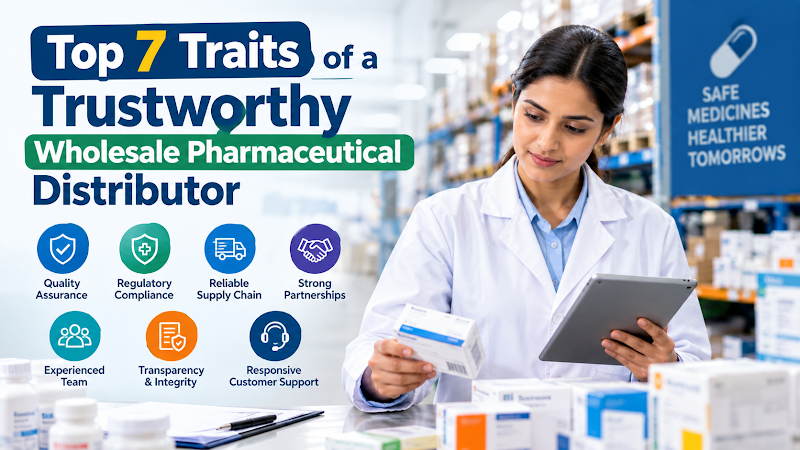
The 7 Traits — and the Questions That Actually Verify Them
This is the verification gap — the distance between what looks trustworthy on paper and what performs reliably under pressure. The 7 traits below exist to close it.
Traits 1–3: Licensing, Traceability, and Sourcing Integrity
Trait 1 — Verified Licensure
DEA registration is the floor, not the ceiling. A credible distributor holds current, discipline-free licensure across every state it services and carries NABP VAWD accreditation or equivalent DSCSA-aligned certification. Ask for a full license portfolio — not a single certificate. If a distributor hesitates, that hesitation is information.
Trait 2 — Full Supply Chain Traceability
DSCSA compliance mandates serialized tracking from manufacturer to point of dispensing. Don’t ask whether a distributor is DSCSA compliant — every distributor says yes. Ask instead: Can you produce a complete transaction history for any unit in your current inventory within 24 hours? The ones who can, do. The ones who can’t, deflect.
Trait 3 — Authorized Distributor of Record (ADR) Status
ADR agreements mean the distributor purchases directly from the manufacturer — not through secondary market channels where product integrity is harder to guarantee. Ask which manufacturers they hold ADR relationships with. A trustworthy distributor names them without hesitation. A vague answer about “extensive supplier networks” is a secondary market signal worth acting on.
Traits 4–5: Storage Standards and Recall Readiness
Trait 4 — Cold Chain and Storage Compliance
USP <797> and <800> set enforceable standards for pharmaceutical storage. Real-time temperature monitoring, validated cold-chain infrastructure, and documented excursion protocols are non-negotiable. Self-reported compliance is not verification. Request third-party storage audit records — a distributor operating at the right standard will have them on file and won’t hesitate to share them.
Trait 5 — Recall Response Protocol
FDA Class I recalls require immediate action. Ask any prospective distributor for their written recall SOP and documented response time from notification to customer alert. No written protocol means their recall response is improvised — an unacceptable risk for any dispensing operation.
The Two Traits Pharmacies Most Commonly Overlook
Trait 6 — Regulatory Audit Transparency
Most pharmacies never ask to see a distributor’s inspection history. Most distributors never offer it. That mutual silence is where risk accumulates. Reliable drug wholesale distributors with strong compliance histories share audit results and corrective action updates on their own. Don’t guess. Ask this question: Have you had any FDA or state board inspections in the past three years? If yes, what happened in those visits? What they say tells you how steady the operation is.
Trait 7 — Dedicated Compliance Support
Customer service and compliance support are not the same role. A named compliance contact — with verifiable pharmaceutical regulatory knowledge — is a structural safeguard, not a customer experience perk. Before signing, ask who your compliance point of contact will be and what their background is. Pharmaceutical suppliers who assign generalist account managers to compliance queries are not structured for accountability. The ones who assign dedicated compliance personnel are.
These two traits are the hardest to fabricate and the easiest to test during vendor evaluation — yet they are the ones most commonly skipped.
How to Apply This Framework Before Signing Any Contract
Treat distributor evaluation as a structured procurement review, not a relationship call.
Before committing, request a formal compliance documentation package: current license portfolio, ADR agreements, cold chain audit records, and a written recall SOP. Run reference checks with at least two active pharmacy clients — not names the distributor selects, but contacts you source independently through industry networks.
Then ask one uncomfortable question in your final evaluation conversation: Walk me through your last recall response — what triggered it, what you did, and how long it took. The specificity of that answer, the speed of it, the absence of defensiveness — tells you more about operational trustworthiness than any document in their compliance package.
A distributor that clears this framework is not just licensed. They are built to perform when it actually matters.
Why Drugzone Pharmaceutical Sets the Standard for Trustworthy Distribution
Drugzone Pharmaceuticals Inc. Is a company that has been approved by the National Association of Boards of Pharmacy. It is also registered with the Food and Drug Administration. This wholesale pharmaceutical distributor has licenses in all 50 states. Has its main office in Nanuet, New York. The company was started by a pharmacist who is licensed in New York. Drugzone brings knowledge and strict following of rules to every partnership. The company has a warehouse that’s 20,000 square feet in size and keeps the temperature controlled. It has than 2,000 different items in stock. It also has relationships with, than 75 direct manufacturers. This shows that the company has built its business around being able to track products not just making sales.
Drugzone is fully DSCSA 2025-compliant with verified ADR sourcing, third-party audit accountability, and dedicated compliance support for every account. With 80+ years of combined leadership experience and 8,000+ customer partnerships nationwide — spanning hospitals, LTC facilities, specialty clinics, compounding pharmacies, and veterinary networks — Drugzone does not just meet the 7 traits outlined in this article. It was built around them.
Frequently Asked Questions
- What is the verification gap in pharmaceutical distributor selection, and why does it matter?
The verification gap is the difference between what a pharmacy can verify – licensure, accreditation, product availability – and what truly shows whether a distributor is operationally trustworthy. The verification gap matters because normal checks, before a contract do not reveal chain failures, hidden secondary market sourcing habits or how a distributor behaves during a recall. Pharmacies that skip this deeper verification take on compliance and patient safety risks that a license lookup will never surface.
- Is DEA registration enough to confirm a pharmaceutical distributor is trustworthy?
No. DEA registration confirms a distributor has met the legal minimum to handle controlled substances. It does not verify supply chain traceability, storage audit history, recall response protocols, or whether the distributor holds direct ADR agreements with manufacturers. Trustworthiness is operational — licensure is only the starting point.
- What documents should a pharmacy request before signing with a new distributor?
At minimum ask for a multi-state license portfolio proof of NABP accreditation or a similar DSCSA-aligned certification, audit records from a third party for cold chain and storage a list of agreements, with ADR manufacturers and a written recall SOP that includes documented turnaround benchmarks. These documents address traits that standard vetting often overlooks.
- How can a pharmacy identify red flags during the distributor evaluation process?
Three reliable signals: a distributor that provides only a single license certificate instead of a full portfolio, vague answers about manufacturer sourcing rather than named ADR partners, and the absence of a written recall protocol. Any hesitation in responding to direct compliance questions — especially about audit history or past recall responses — is itself a red flag worth acting on.
Disclaimer: The information provided in this article is for general informational and educational purposes only. While we try to keep the content accurate and up to date, details may change over time. Readers should verify important information from official or reliable sources before making any decisions. We do not guarantee the completeness or accuracy of the information and are not responsible for any loss or consequences resulting from its use.