Aluminium glass doors have fundamentally changed how Indian homes are designed, shifting from functional openings to architectural centrepieces that connect interior spaces with the outdoors. This article traces that evolution, exploring how modern glass door design, slim profiles, and certified performance have made aluminium the material of choice for contemporary residential architecture.
Not so long ago, a door was simply a door. It closed a room off from the world, provided security, and perhaps, if you were lucky, admitted a modest shaft of light through a narrow glazed panel above or beside it. The idea that a door could define a room’s character, shape how light moved through a home, or dissolve the boundary between inside and outside was largely the preserve of architects working on exceptional projects with exceptional budgets.
That has changed completely. Across India’s residential landscape today, from premium apartments in South Mumbai to independent bungalows in Bengaluru’s quieter neighbourhoods, aluminium glass doors have become a defining feature of how homes are conceived, designed, and experienced. They are not additions to a room. In many cases, they are the room’s most important element.
Understanding how this shift happened, and what it means for homeowners making decisions today, requires looking at both the design philosophy and the engineering that made it possible.
From Functional Opening to Architectural Statement
The earliest residential glass doors were modest propositions. A single pane set within a heavy timber or mild steel frame, they admitted light but offered little in the way of visual elegance or spatial connection. The frame dominated; the glass was incidental.
The shift began when architects questioned the wall itself as the default organising element of residential space. If a home’s relationship with natural light, outdoor views, and the surrounding landscape could be transformed by replacing solid material with glass, why treat glazing as secondary? This reframing, from window-in-wall to glass-as-wall, is what drove the earliest experiments with large-format glazed doors and, eventually, the sophisticated aluminium glass door systems available today.
What accelerated the shift was materials science catching up with design ambition. As long as frames needed to be thick and heavy to carry large glass panels, the visual result was always compromised, a grid of intrusive frame elements that undermined the very transparency they were meant to provide. The development of high-strength aluminium alloys fundamentally changed the equation, enabling slim profiles that could carry significant structural loads without dominating the visual field.
The Role of Aluminium in Modern Door Design
Aluminium’s rise as the dominant material for modern glass door design is not accidental. It is the direct result of properties that other materials simply cannot replicate in combination: high strength, low weight, dimensional stability across temperature extremes, corrosion resistance, and the ability to be extruded into complex, precision profiles at consistent quality.
Where timber warps and swells under India’s monsoon humidity, aluminium holds its shape. Where uPVC requires steel reinforcement for larger spans, adding bulk that defeats the purpose of slim design, aluminium achieves structural performance inherently, in less material. This is why premium aluminium door design has become the architect’s default choice for any application that requires large glass panels, minimal frames, and long-term reliability.
The development of advanced proprietary alloys has pushed this further. Duranium, developed by Hindalco for Eternia’s door and window systems, is 40% stronger than standard aluminium alloys. This additional strength is what allows sightlines, the visible frame width, to be reduced to as little as 20mm in some configurations, creating an effect that reads as near-frameless glazing rather than a conventional door. For aluminium glass door design that prioritises unobstructed views and maximum light, this engineering distinction is not minor. It is the difference between a door that serves the view and one that competes with it.
How Sliding Glass Doors Redefined Indoor-Outdoor Living?
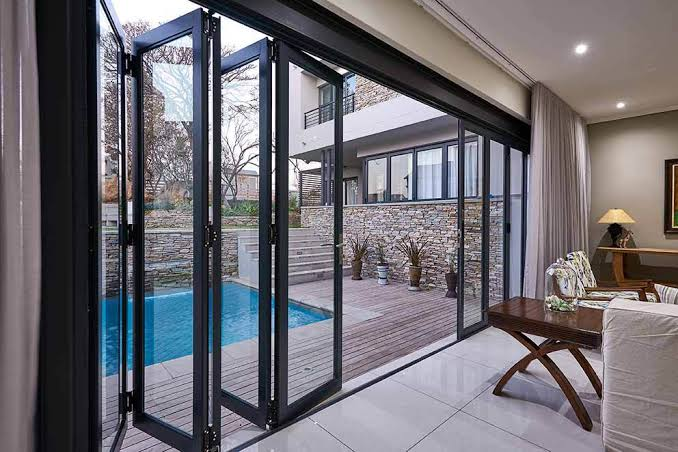
Of all the door configurations that have shaped contemporary residential design, the sliding glass door has arguably had the deepest impact. Its appeal is intuitive: rather than swinging into a room and consuming floor space, sliding panels glide laterally, disappearing into a pocket or stacking beside the opening. The result, when done well, is an aperture that can span an entire wall, turning a room’s edge into a threshold rather than a barrier.
The evolution from basic sliding doors to today’s lift-and-slide and minimal sliding systems represents decades of incremental engineering refinement. Early sliding doors were functional but limited: modest panel sizes, visible tracks, and weather performance that left something to be desired in monsoon conditions. Contemporary systems are a different proposition entirely. Lift-and-slide mechanisms allow panels weighing up to 400 kilograms to move with a single finger. Flush bottom tracks eliminate trip hazards and create seamless floor transitions. Certified weather performance, in Eternia’s case, a WiWA score of 10/10 for wind, water, and air, means these doors perform as impressively in a coastal storm as they look in an architect’s rendering.
This combination of scale, ease, and certified performance is what makes the modern sliding glass door central to the open-living philosophy that now defines premium residential design across India.
Aluminium Door Design in Contemporary Indian Homes
The appetite for sophisticated aluminium glass doors in Indian residential projects has grown considerably, and the projects where these systems appear tell their own story. Large-scale developments from Hyderabad to Chennai, high-rise towers in South Mumbai, and private residences across Lonavala, Karjat, and Kochi have embraced aluminium glass door design as a primary architectural gesture rather than a finishing detail.
What’s striking about the best of these projects is how the door does multiple things at once. It manages light, admitting it generously when open, filtering or reflecting it when closed with tinted or double-glazed panels. It manages the indoor-outdoor relationship, creating connection when desired, separation when needed. And it manages aesthetic tone; the choice between Pearl White, Graphite Grey, Night Black, or a warm Walnut wood-grain finish shapes the entire character of the space the door inhabits.
The colour and finish range available in modern aluminium doors has expanded considerably, and this breadth is worth appreciating. Powder-coated finishes in contemporary tones sit alongside wood-grain transfers that convincingly replicate timber’s warmth, without timber’s vulnerability to moisture, insects, or sustained UV exposure. For Indian homeowners who love the look of timber but live in environments that would destroy it within a decade, this is a genuinely compelling proposition.
The trajectory of aluminium glass door design points toward even greater integration of performance, aesthetics, and intelligence. Smart glass technology, already available in Eternia’s range as switchable glass that transitions from transparent to opaque on demand, will become more accessible and more refined. Thermal performance will continue to improve as glazing technology advances, making large glass doors more compatible with energy-efficient homes even in India’s most demanding climate zones.
What the Future Holds for Residential Glass Door Design?
The structural ambitions of architects will also continue to grow. As confidence in high-performance alloy systems increases, panel sizes will extend further, sightlines will narrow, and the visual distinction between a glass door and a glass wall will continue to blur. This is the direction that the most ambitious residential design is already heading, toward homes where the boundary between inside and outside is not so much managed as gently, elegantly dissolved.
For homeowners considering aluminium doors today, the advice is consistent: invest in performance certification, prioritise slim profiles and quality hardware, and think of the door not as a functional element but as an architectural one. The right aluminium glass door doesn’t just open a room to the world outside. It reframes how that room, and the home it belongs to, is experienced every day.