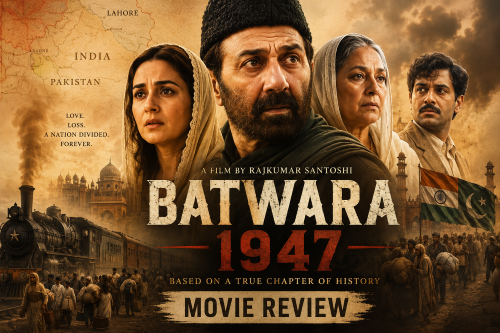
Batwara 1947 is one of the most anticipated Hindi period dramas of 2026. Directed by Rajkumar Santoshi and produced by Aamir Khan, the film brings together Sunny Deol, Preity Zinta, Shabana Azmi, Karan Deol and Ali Fazal in a story set against the painful backdrop of the 1947 Partition. The movie was earlier titled Lahore 1947 before being renamed Batwara 1947. It is scheduled for a theatrical release on August 14, 2026.
Expected verdict: Promising — worth watching for fans of historical and emotional dramas.
Rating before release: ★★★★☆ (4/5 expectation)
The real test will be whether Batwara 1947 can move beyond the familiar imagery of Partition and tell a deeply human story about families, relationships, survival and hope. If it succeeds in doing that, the film could become one of the more memorable historical dramas of 2026.
Because the film releases on August 14, a complete audience-based review and final verdict can only be given after watching the theatrical release. So, this review focuses on the film’s announced story, performances visible in promotional material, filmmaking team and overall expectations rather than pretending to have seen the unreleased movie.
Batwara 1947: Story and Premise
The Partition of India remains one of the most painful chapters in the history of the Indian subcontinent. Millions of people were forced to leave their homes, families were separated and communities that had lived together for generations were suddenly divided.
Batwara 1947 uses this historical period as the foundation for a personal human story. The narrative reportedly revolves around Sikander Mirza, played by Sunny Deol, and his family as they navigate the extraordinary circumstances created by Partition. Preity Zinta plays Hamida Mirza, while Shabana Azmi has an important role as Mai.
The central appeal of the story is that it appears to focus not simply on political events but on the ordinary people who had to live through them. Sunny Deol has also emphasized that audiences should approach the film as a story about people rather than forming a political opinion before watching it.
That approach could give the film emotional depth if the personal stories remain at the heart of the screenplay.
Sunny Deol as the Lead
Sunny Deol is perhaps the biggest reason audiences are interested in Batwara 1947. The actor has already played several memorable characters in patriotic and historical dramas, most famously in films such as Border and Gadar.
However, this film has the potential to present him in a somewhat different emotional setting. Instead of relying only on action or powerful dialogues, the character of Sikander Mirza appears to require a mixture of strength, vulnerability and responsibility.
Sunny’s commanding screen presence can work particularly well in a period drama. At the same time, the film will need to give him enough quiet and emotional moments rather than depending entirely on his familiar larger-than-life image.
Preity Zinta’s Comeback Appeal
Preity Zinta’s presence adds another major attraction. Her pairing with Sunny Deol has nostalgic value because the two actors have previously worked together successfully.
In Batwara 1947, Zinta plays Hamida Mirza, giving her a character connected closely to the family and the emotional consequences of Partition.
Her performance could become one of the film’s strongest elements if the screenplay allows the character sufficient emotional space. A Partition drama needs believable relationships because the audience must feel what the characters stand to lose.
Shabana Azmi, Ali Fazal and Supporting Cast
The supporting cast is another major strength on paper. Shabana Azmi brings decades of experience in emotionally demanding roles, while Ali Fazal plays poet Nasir Kazmi. Karan Deol also appears as Javed Mirza. Abhimanyu Singh plays Yaqoob Pehalwan.
A strong ensemble is particularly important in a historical drama because the story often moves between family relationships, social tensions and larger historical events.
Shabana Azmi’s presence is especially interesting because her style of performance could add maturity and emotional realism to the film.
Rajkumar Santoshi’s Direction
Rajkumar Santoshi is a filmmaker known for handling subjects involving strong emotions, social conflict and historical themes. His collaboration with Sunny Deol is also notable, making Batwara 1947 a project with considerable expectations.
The biggest challenge for Santoshi will be balancing spectacle with humanity.
Partition stories can easily become dominated by violence, political speeches and dramatic confrontations. The more difficult task is showing how ordinary people experienced the upheaval—losing homes, searching for relatives and trying to protect their families.
If Santoshi keeps the human story at the centre, the film could have a stronger emotional impact.
Cinematography and Period Setting
The film’s visual department is another reason to be curious. Santosh Sivan is credited as cinematographer, while the production design and period setting are expected to recreate the atmosphere of the 1940s.
A movie about Partition needs convincing locations, costumes, vehicles, homes, railway stations and crowded migration sequences. These details can make the historical setting feel authentic rather than looking like a modern film wearing period costumes.
The available information also indicates that the movie deals with the difficult migration experienced by people during Partition, including overcrowded trains and journeys toward a new life.
Music and Background Score
Music is being handled by A. R. Rahman, with lyrics by Javed Akhtar.
This combination naturally creates high expectations. A story involving separation, migration, memories and loss provides plenty of opportunities for emotionally powerful music.
The soundtrack should ideally support the story rather than interrupt it. In a serious period drama, background music can be particularly effective when used subtly during emotional and dramatic sequences.
What Works in Batwara 1947?
Based on the announced details, several elements make the film promising:
- A powerful historical backdrop
- Sunny Deol and Preity Zinta reunited on screen
- Strong supporting performers
- Rajkumar Santoshi as director
- Aamir Khan as producer
- A. R. Rahman handling the music
- Santosh Sivan behind the camera
- A story focused on the human consequences of Partition
The combination of these names gives the film considerable credibility even before its theatrical release.
What Could Hold the Film Back?
The biggest challenge is its subject matter. Partition has already been explored in numerous Indian films, so Batwara 1947 needs to offer something emotionally fresh.
There is also a danger of becoming overly dramatic. If the screenplay relies too heavily on familiar Partition clichés, the film could feel predictable.
Another challenge is its length. The listed runtime is approximately 2 hours and 25 minutes, which means the screenplay will need to maintain a good pace throughout.
Final Verdict
Batwara 1947 looks like an ambitious historical drama built around a powerful subject and an impressive cast and crew. Sunny Deol’s presence, Preity Zinta’s return, Rajkumar Santoshi’s direction and Aamir Khan’s production involvement make it one of the notable Hindi releases of the Independence Day weekend.
However, since the film is releasing on August 14, 2026, a genuine final review should wait until the movie is actually seen in theatres.